
I guess it is time for me to concede my battle against "out of" to the all-powerful "usage" rule.
In his column of March 21 in the Toronto Star, James Travers wrote, "... decision to pay executive bonuses out of a bailout."
The word "from" should replace "out of".
I heard the same term on the news tonight: "The last workers walked out of the building today." A better form would be: "The last workers left the building today."
"Out of" can always be replaced with a better choice of words. Unfortunately, "out of" has become acceptable everywhere. I have just finished reading a very good novel, and the author used "out of" many times.
It is especially discouraging to find myself making this terrible grammar mistake as well! Usage has won the battle!
Tuesday, March 31, 2009

Thursday, March 19, 2009
Did you say "had not took?"
I must say that I am completely discouraged about the future of the English language. It is gradually and relentlessly being destroyed by people who should know better. The basic problem is that these people are totally unaware of how little they know about the structure of our language.
The problem to which I refer in the title is based on inadequate understanding of verbs in the English language. The past tense of a regular verb is formed by adding "ed" to the base. For example, the verb, "to walk" (this is the infinitive form):"walked" is the form used for the past tense.
However, many of our frequently used verbs are irregular in form. For example, "to take". The simple past tense is "took", and you say, "I took". But if you want to use the pluperfect past tense, you must use the past participle "taken" with an auxiliary verb: "I had taken".
I was disgusted this morning to read an article on the MSN Sympatico home page written by Jeffrey Baynes (MSN shopping editor)in which he said, "...and wonder why I had not took the plunge yet"!
That affects me like fingernails on a blackboard!
Refer to my previous post from March 2, 2009.
The problem to which I refer in the title is based on inadequate understanding of verbs in the English language. The past tense of a regular verb is formed by adding "ed" to the base. For example, the verb, "to walk" (this is the infinitive form):"walked" is the form used for the past tense.
However, many of our frequently used verbs are irregular in form. For example, "to take". The simple past tense is "took", and you say, "I took". But if you want to use the pluperfect past tense, you must use the past participle "taken" with an auxiliary verb: "I had taken".
I was disgusted this morning to read an article on the MSN Sympatico home page written by Jeffrey Baynes (MSN shopping editor)in which he said, "...and wonder why I had not took the plunge yet"!
That affects me like fingernails on a blackboard!
Refer to my previous post from March 2, 2009.
Saturday, March 14, 2009
Pension Benefits
It has been an enlightening experience to learn about the perks that auto workers take for granted. The news conference with details of the proposed contract with GM on March 8, 2009 provided me with information that I never had before.
The "copay" idea for health benefits, for example! As a retired teacher who stayed home to raise her children, I have a small pension based on nineteen years of teaching (the first three were part-time). I am presently paying 10% of my gross annual pension for drug and extended health care coverage. The premium I pay does NOT include dental coverage. I didn't think I could afford the extra $100 a month for dental coverage that in reality provides only 50% coverage.
But as I listened to the news conference, I learned that the pensioned auto workers had total health care benefits provided completely by their former employer. I also understand that the workers also have a complete and free package of health benefits! I don't know whether this amazing coverage is based on a group plan with an insurer, or whether it is completely financed by GM.
The head of CAW apologized to the pensioners, saying that they have the best record for looking after their pensioners! How true! I would love to only pay $15 a month for a complete benefits package!
The "copay" idea for health benefits, for example! As a retired teacher who stayed home to raise her children, I have a small pension based on nineteen years of teaching (the first three were part-time). I am presently paying 10% of my gross annual pension for drug and extended health care coverage. The premium I pay does NOT include dental coverage. I didn't think I could afford the extra $100 a month for dental coverage that in reality provides only 50% coverage.
But as I listened to the news conference, I learned that the pensioned auto workers had total health care benefits provided completely by their former employer. I also understand that the workers also have a complete and free package of health benefits! I don't know whether this amazing coverage is based on a group plan with an insurer, or whether it is completely financed by GM.
The head of CAW apologized to the pensioners, saying that they have the best record for looking after their pensioners! How true! I would love to only pay $15 a month for a complete benefits package!
Monday, March 2, 2009
Did you say "between you and I"?
Too many people in high places are ruining the English language. This is the outcome of grammar no longer being taught as a subject in our schools.
When I was taking my teacher training at the Ontario College of Education in Toronto in 1966, we were given a publication from the Ministry of Education which stated that grammar would no longer be taught as a subject.
The outcome of this poor idea is audible everywhere. Many principals, teachers and reporters lack an understanding of the basic grammatical function of certain parts of our language.
For example: "Between you and I" is incorrect. An easy way to test this is to change to the plural form: Would you say "Between we"? No, you would say, "Between us". Therefore, the correct form is "Between you and me".
Why is one form correct, and not the other? Why do most people have no problem with one, but can't solve the problem when "I" is in the mix?
Have you heard "for you and I"? This is not correct! Would you say "for I"? NO! You would say "for me". When "you" is added, the correct form is still "for you and me".
There are two forms of pronouns: the subjective and the objective form. The subjective form is the subject in the sentence (the subject of the verb).
I,he, she, we, and they are subjective pronouns.
Me, her, him, us and them are objective pronouns. That means that after a preposition such as between, for, from, etc., you do not use "I"; rather, you must use "me".
When I was taking my teacher training at the Ontario College of Education in Toronto in 1966, we were given a publication from the Ministry of Education which stated that grammar would no longer be taught as a subject.
The outcome of this poor idea is audible everywhere. Many principals, teachers and reporters lack an understanding of the basic grammatical function of certain parts of our language.
For example: "Between you and I" is incorrect. An easy way to test this is to change to the plural form: Would you say "Between we"? No, you would say, "Between us". Therefore, the correct form is "Between you and me".
Why is one form correct, and not the other? Why do most people have no problem with one, but can't solve the problem when "I" is in the mix?
Have you heard "for you and I"? This is not correct! Would you say "for I"? NO! You would say "for me". When "you" is added, the correct form is still "for you and me".
There are two forms of pronouns: the subjective and the objective form. The subjective form is the subject in the sentence (the subject of the verb).
I,he, she, we, and they are subjective pronouns.
Me, her, him, us and them are objective pronouns. That means that after a preposition such as between, for, from, etc., you do not use "I"; rather, you must use "me".
Thursday, February 26, 2009
What Did You Say?
I consider Peter Mansbridge of CBC News to be the "Voice of Canada".
I was therefore appalled and devastated to hear him use the word "quicker" when he introduced The National at 10 PM (EST) on February 25, 2009.
This word does not exist in the English language! The word, quick, is an adjective, and modifies a noun. To use this word as an adverb, the suffix "ly" must be added. Peter should then have said "more quickly" to express his meaning.
The word, fast, is both an adjective and an adverb, and can have the suffix "er" added. But in this instance, using "more quickly" better suits "The National".
I wonder if Lloyd Robertson would have made the same mistake?
I was therefore appalled and devastated to hear him use the word "quicker" when he introduced The National at 10 PM (EST) on February 25, 2009.
This word does not exist in the English language! The word, quick, is an adjective, and modifies a noun. To use this word as an adverb, the suffix "ly" must be added. Peter should then have said "more quickly" to express his meaning.
The word, fast, is both an adjective and an adverb, and can have the suffix "er" added. But in this instance, using "more quickly" better suits "The National".
I wonder if Lloyd Robertson would have made the same mistake?
Saturday, February 21, 2009
Adult in Charge
Our North American society made a big step forward when physical punishment was recognized as the totally wrong approach for teaching children how to behave.
In fact, the clue to our changing ideas is present in the previous statement. We finally realized that the goal we all have is to "teach" our children. Physical punishment did teach children something: "might is right". Every child who was hurt by his parent decided that one day, when he was big enough, he would have control.
So parents today are generally in uncharted territory. Remember that "discipline" has the Latin root meaning to teach or to train.
The first thing to remember is that every child wants to feel safe. As a parent of a toddler or preschooler, you need to feel confident that you do know best in the situation. This confidence is conveyed by making your expectations clear, and by not giving in to tantrums, etc. It may surprise you, but your child wants to feel that you know best. Then he feels safe and protected.
Exhibit self-discipline: expect from yourself what you expect from your child. Remember that you are "the adult in charge".
In fact, the clue to our changing ideas is present in the previous statement. We finally realized that the goal we all have is to "teach" our children. Physical punishment did teach children something: "might is right". Every child who was hurt by his parent decided that one day, when he was big enough, he would have control.
So parents today are generally in uncharted territory. Remember that "discipline" has the Latin root meaning to teach or to train.
The first thing to remember is that every child wants to feel safe. As a parent of a toddler or preschooler, you need to feel confident that you do know best in the situation. This confidence is conveyed by making your expectations clear, and by not giving in to tantrums, etc. It may surprise you, but your child wants to feel that you know best. Then he feels safe and protected.
Exhibit self-discipline: expect from yourself what you expect from your child. Remember that you are "the adult in charge".
Monday, February 9, 2009
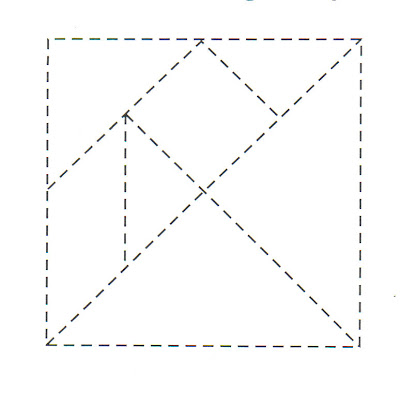
What is a tangram?
A tangram consists of seven geometric shapes that can be fitted together to make a square.
In my post on February 7, I mentioned two books that I used in my classroom to teach tangrams. Tangrams can be re-arranged into various shapes and are a valuable teaching tool for geometry. The students enjoy the challenge of re-arranging the tangram shapes into different shapes.
It is possible to buy plastic tangram sets for your class. Have your class sit in a circle and practise with the individual sets to copy the shapes from the stories. The biggest challenge is to re-form the square!
Click in the on the image to enlarge and print.
In my post on February 7, I mentioned two books that I used in my classroom to teach tangrams. Tangrams can be re-arranged into various shapes and are a valuable teaching tool for geometry. The students enjoy the challenge of re-arranging the tangram shapes into different shapes.
It is possible to buy plastic tangram sets for your class. Have your class sit in a circle and practise with the individual sets to copy the shapes from the stories. The biggest challenge is to re-form the square!
Click in the on the image to enlarge and print.

Subscribe to:
Posts (Atom)

