Wednesday, September 28, 2011

The Dingle Dangle Scarecrow


This is one of my favourite fall poems. The words create very vivid images and the rhythm is very appealing to young children. I have two scarecrows that I use as a focal point while we recite the poem. We spend a month approximately with this poem and I always begin it on the first day of fall.

Poetry is an effective tool for learning to read. Shorter poems of four to eight lines can be learned in a week, and the students put the sheet in their duo-tang on Friday. They point to the words as they recite the poem and learn to move their finger under each word as they "read" the words.

Click to enlarge and print.

The Dingle Dangle Scarecrow

Thursday, September 15, 2011

Nature Deprivation

I have heard that young people are suffering from "nature deprivation". I saw this very clearly recently when I was watching a tournament for high school students on Jeopardy. The young "whiz kid" was shown a picture of two acorns attached to a branch with a leaf visible. The correct answer was "oaks" from the proverb about the acorn and the mighty oak. The girl said "pines". I concluded that she did not recognize oaks or pines.

This anecdote definitely indicates a trend. Young people are being separated from nature because of lifestyle. When was the last time you saw a child lying in the grass looking at the clouds?

Most people think chickens lay eggs. What is a hen? What does a rooster do? (Besides crow, that is?) And how many people younger than 50 have heard a rooster crow for that matter?

How many young people have seen vegetables growing in a garden?

Something to think about!

I would like to suggest a wonderful book for parents to buy for their children:
In My Backyard by Margreit Ruurs, illustrated by Ron Broda, a Canadian who does paper sculpture art.

Friday, September 9, 2011

September in Grade One

Another year at school has begun and most of the students in grade one are very excited to be back at school.

The most important thing to teach in grade one is routine, routine, routine! Remember that two months ago, these students were in kindergarten.

In fact, introducing students to the grade one curriculum needs to be secondary to routine. Do not panic and think that you will not cover the curriculum if you don't start immediately! Students who understand the classroom routines will feel secure and learn more efficiently.

I usually leave social studies and science until the third week of September. I spend the first two weeks concentrating on reading stories, learning rhymes, simple numeration, and most important of all, beginning a writing program.

The students have a journal of course, but I like to begin right away teaching them to organize a notebook and to copy a sentence from chart paper. The first page has two sentences:

My name is______.

I am a girl. (or boy)

The notebook has the same format as their journal, and they are expected to illustrate what they have written.

This notebook is a very important part of the students' writing program because they learn to organize, copy, and they are using words that are part of their experience.
Thursday, March 10, 2011

Earth and space strand integrates with math

I discovered that I loved science when I started teaching science to grade one! I really liked using the earth and space strand for teaching graphing in math. The first time in the year that I used this technique was the month of November. We kept track of the weather every day, and made sure to record the weekend weather every Monday. I chose November because there is always a wide variation in the weather. I used adjectives: sunny, cloudy, rainy, snowy. I chose these four because they were fairly objective, and we always checked off the weather after first recess.

At the end of the month, I photocopied the 8x11 sheet with the class record of weather for each student. Each student had a graph with 4 columns and 30 rows, with the labels at the bottom. They were already familiar with making bar graphs because we had previously spent time graphing objects in the classroom as a class activity, and smarties after Halloween.

At this point in the year, I did not have them answer written questions about their findings, but I expected them to make oral comparisons.

During the month of March, we tracked windy and calm days. I sent home a sheet for them to keep track over the March break which they were to return to school afterwards. (This sheet was decorated with clip art for St. Patrick's Day which they had coloured in class on the last day before the holiday.) At the end of the month, each student used his own sheet along with a photocopy of our class record to complete a bar graph and answer written questions about the information.

The month of April was another good month for tracking weather because of the variable weather April usually brings! When they completed their bar graph at the end of the month, I expected them to record their findings independently. I usually did a survey about whether there would be snow in April as well, and made a record on chart paper - a variation of probability!

Monday, February 28, 2011

Another fabulous story for tangram shapes

I read this story to the class after we had read Grandfather Tang's Story. This story went well with the strand for structures in the science curriculum. The class was already familiar with the Three Little Pigs; in fact,I always included this story as one of the picture books for integrating language and science.

This is the story of three other little pigs who meet a wolf. Each pig is given seven magic shapes by an animal. Two pigs choose unwisely and are eaten by the wolf. The last pig (a girl!) makes a better choice.There are eight different shapes in the story.

Every class loved this story. Afterwards, each student used his own set of plastic tangram shapes to reproduce the shapes in the story. Then each student reproduced one shape with construction paper, and then told the story of the shape he chose.

Three pigs, One Wolf, and Seven Magic Shapes

Monday, February 14, 2011

The Key to Your Primary Music Program: List of songs with lesson plans

I want to post the list of songs that we published in our Primary book so that you can see the variety of songs in the book. I must stress that you should not be fooled by the apparent simplicity of the songs. They are all from the public domain, and have stood the test of time. These songs were selected because they are suitable for use when teaching the skills that are required in the curriculum. As your students become more skilled in singing on key, you can choose other songs for themes and seasons.

I have written about our two music books in more detail in previous posts. You can also check out our website.

Click on the image to enlarge and print.

List of primary songs with lesson plans

Friday, February 11, 2011

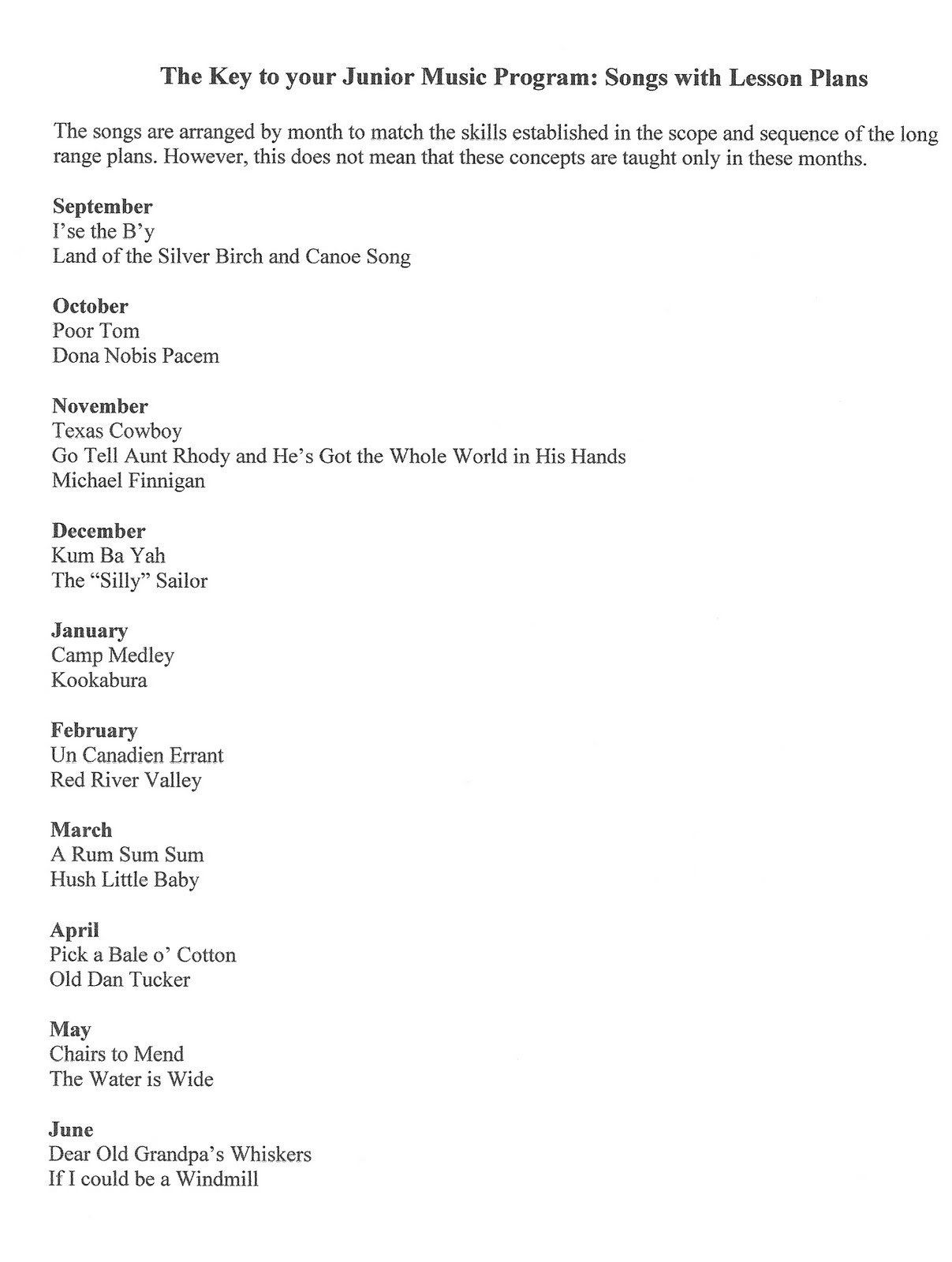
The Key to your Junior Music Program: List of songs with lesson plans

I have referred to this book in a previous post. The songs are all public domain, and they have stood the test of time. These are songs that my sister (my co-author) taught her grade 4, 5 and 6 classes over her many years as a music teacher in Ontario. Check the list and consider buying our book from our website.

Click on image to enlarge and print.

list of junior songs